
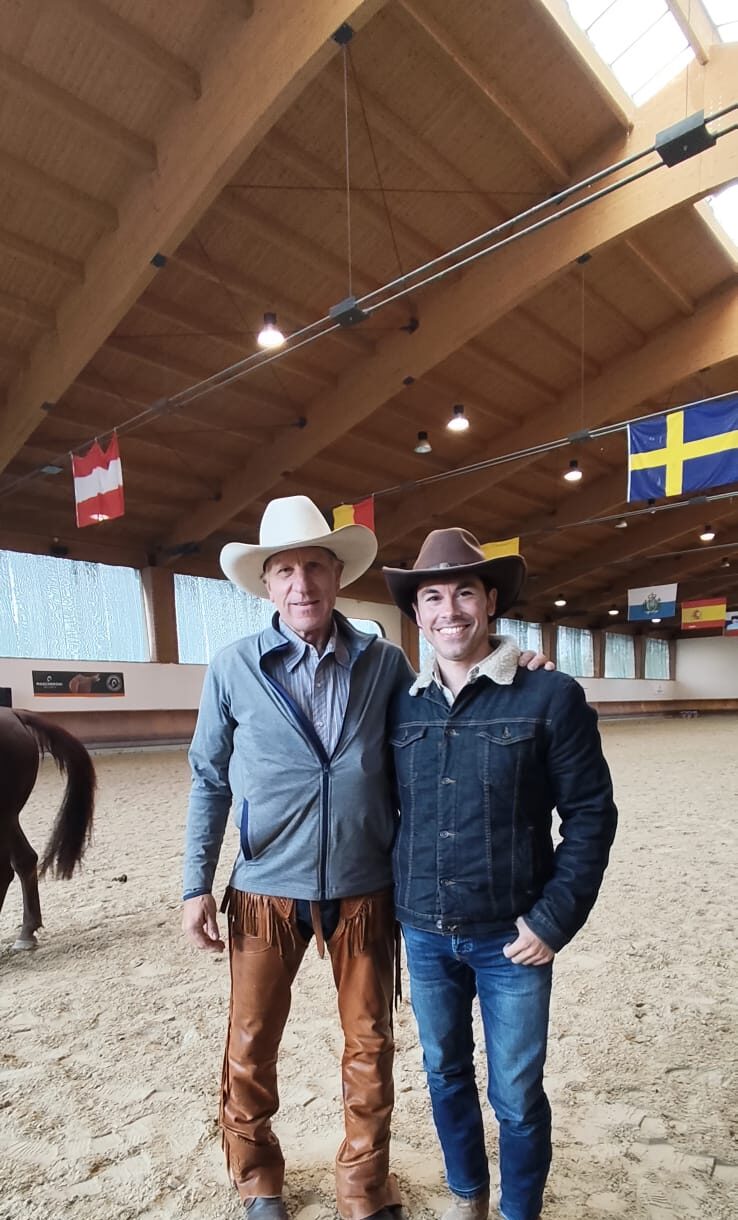
Buck Brannaman: When the horse is the mirror
There are teachers who don’t raise their voices. They don’t need to.
This weekend I was in Milan at a clinic with Buck Brannaman, considered by many to be the best horse trainer in the world. These were days of observing, reflecting, and learning. I am still digesting it all.
Who is Buck Brannaman?
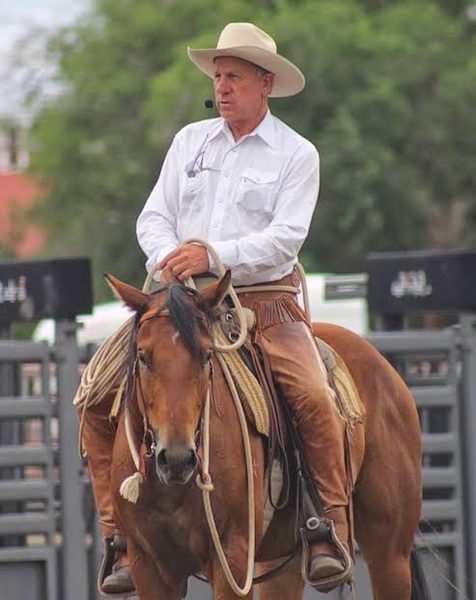
Born in 1962, Buck is one of the great figures of horsemanship rooted in the vaquero tradition. His philosophy is simple to state but very difficult to practice: work with the horse’s nature, understand how it thinks and communicates, and help it trust humans rather than forcing it into submission.
His path wasn’t easy. He grew up in a home marked by his father’s violence. It was a football coach who noticed the bruises, and thanks to that, Buck ended up with a foster family that brought him closer to horses. Later, he became a disciple of Ray Hunt, a leading figure in working with horses through sensitivity, following the lineage of Tom Dorrance. Perhaps that is why he recognizes fear when he sees it. And he knows it is not cured with more pressure.
He reached the general public through The Horse Whisperer. He was the main consultant for the Robert Redford film and is considered the real-life inspiration for the protagonist. Then came Buck (2011), the Sundance-winning documentary by Cindy Meehl. It shows a man who spends about forty weeks a year traveling from ranch to ranch giving clinics.
He sums it up with an unforgettable phrase: he often doesn’t help people with horse problems, but horses with people problems.
Feel, time, and balance
Buck teaches the classic principles of equitation through three concepts: feel, time, and balance.
The saddle, the hat, or the cap do not matter. Neither does the riding discipline, the breed, or the horse’s experience. In the arena, there were riders from very different backgrounds, and all worked on the same foundations.
The truth is, Buck does not teach a discipline. He teaches a way of being with the horse.
What I take away
If I had to summarize it in a single idea, it would be this: putting yourself in the horse’s place. In its body and its mind.
It is about discovering how it thinks, how it perceives you, and what it needs so that your idea can become its idea too. Not through imposition, but through understanding. If you understand how it perceives the world, you understand how to adapt to it. And then a meeting point appears where the horse can understand you.
What Buck transmits is not about training an animal. It is about the two of you functioning as a single mind and a single body. It is a goal that can be pursued for a lifetime. And for that very reason, it is worth it.
Horses don’t lie
I also hold on to his way of looking at discomfort. The question is not how much you can demand, but how much the horse can do without feeling uncomfortable. Sometimes the responses will be imprecise or will come with some worry. That is not the end of the road; it is a phase of the process. The goal is for the horse to learn what you ask without getting upset. And for both to learn at the same time.
This demands something that is difficult for us as people: adapting. Approaching the horse on its own terms, not demanding simple obedience. What works with one does not work with another. Yet, we often cling to a method and expect all horses to conform to it. It does not work.
There are also moments when the horse must change its behavior, because what it does could put us in danger. But even then, the path is the same: finding a middle ground together. Neither above nor below. We have an equal right to be there. He also has his rights, and it is up to us to respect them.
Because the horse doesn’t lie. It reflects what we carry inside: our tension, our rush, our clarity, or our doubt. It is an honest, and sometimes uncomfortable, mirror.
At Cavalls de Calma, we work from this very conviction. That the horse doesn’t just teach us how to ride. It teaches us to look at ourselves.
Because sometimes, to learn, it is enough to stay quiet… and let the horse tell us how we are doing.
About the author
Gerard Magín
Founder and director of Cavalls de Calma, a leadership and personal development consultancy located in Sant Cugat del Vallès, and a professor at the University of Barcelona. He holds a degree in Communication Sciences, a Master’s in Teacher Training, and is certified in Systemic Coaching. He has over 15 years of corporate experience in marketing, events, and team management. As an Equestrian Sports Technician and specialist in equine ethology, he unifies business methodology with animal behavior to structure high-performance training processes based on experiential learning and objective biofeedback.
